August 07, 2010

Down with FUD! (2)

As I posted a couple of years ago, this is a useful acronym, usually taken to represent "Fear, Uncertainty, and Doubt".

It is a sneaky but very effective way of undermining or discrediting others, and to quote from my earlier post,
  • In marketing or politics, the advantages of changing the direction of someone's loyalties are obvious ...
  • In other areas of life it can be used in a more subtle way, by gradually isolating someone from former associates ...
  • Sometimes it may achieve nothing more than intellectual satisfaction, or a sense of having influence.
Having seen this technique used to great effect in recent months, in both work and hobby situations, I can now pass on what I have learned. It won't help me, of course, but it may allow others to see what is coming.
FUD Primer
1. Gain a position of authority.
It can be as spurious as you like, but must allow you to humiliate and/or harrass those "beneath" you, without fear of censure.

2. Find a suitable target (or targets, if you have plenty of experience)
Desirable characteristics are an eagerness to contribute, a strong work ethic, and high levels of energy. Such people are easily ridiculed as "needy" - which starts the undermining process.

3. Fear is the Key
Start by demonstrating your "power" in as many subtle ways as you can manage. Ideally, these should be directed at your target in such a way that they completely understand that you hold all the cards.

4. Introduce Uncertainty
Once you have made your target sufficiently apprehensive, you and your colleagues can bombard them with contradictory instructions. If you have made them anxious enough, this will create the pleasing effect of complete confusion, as they will not know which way to jump without landing in trouble. Your work is nearly done.

5. Doubt and Despair
Your victim will be unable to juggle all the conflicting information they receive, and they will inevitably drop one of the balls. This is your cue to act in a suitably decisive manner, humiliating the target in a way that serves as a warning to others.

6. Follow through
It is essential to maintain complete solidarity with your colleagues after such a campaign, in case of tiresome repercussions or even a challenge to your authority. Such insubordination can usually be overcome by subtle harassment and warnings about further punitive actions.

Anti-FUD Tactics
1. Be Brave
Remember what your mother told you about sticks and stones? This stuff hurts, but it does not actually injure you.

2. Retain Your Values
Nobody can take these away from you. These people can ridicule and criticise as much as they like, but only you can revise your ideals.

3. Use Humour
A sense of humour is rare among those who rely on FUD to achieve their goals or justify their positions, so this can be a powerful defence. It could well be seen as insubordination, and punished as such, but a cheery smile can be an unnerving response, and it will make you feel better.

4. Learn to Cope
Remember:

nil desperandum illegitimi carborundum

July 07, 2010

DMOZ Editor Corruption Shock (3)

I thought I made my point clearly enough the first time I wrote about the relentless campaign of vague, repetitive and unsubstantiated accusations thrown at volunteer editors in the Open Directory Project.

Unfortunately, subsequent insulting comments to this blog showed that those making the allegations had not even read that post, or had missed its message completely. So I tried again, pointing out the obvious flaws in their copycat claims. Sadly, this was equally ineffective, and I continue to receive (and read elsewhere) the same tiresome arguments and insults. I will present one such email later in this post.

But first I'll present the facts again, very simply and in large friendly letters this time.

1. It is always free to suggest a site to ODP/DMOZ ... why pay?
2. DMOZ is not a listing service. Suggested sites are just one of many resources for volunteer editors, who are the only people who can list sites in the directory.
3. Nobody can "get" a site listed, no matter what they might promise hopeful webmasters.
4. Anybody can easily check such claims: is the person named as an editor in that DMOZ category or anywhere else?
  • If not, they simply cannot do what they promise.
  • If they are listed as an editor, then they already know that requesting or accepting any form of payment will lead to permanent closure of their account. Besides, sites which are the subject of editor bribes (and even attempted bribes) are permanently banned.
Yes, that's right, the sites are permanently banned - even if they are involved in just an offer to pay.

But you don't have to take my word for this. See if you can find any DMOZ listings which have resulted from the thousands of payment offers made on various freelancer sites and webmaster forums.
  • If you do find such a listing, you know where to report it. (Of course if you believe that the entire worldwide volunteer community is engaged in a colossal cover-up over a single site, there's not much point in any discussion.)
  • If you don't find any such listings, then obviously these ineffectual offers don't "prove" editorial abuse. All they "prove" is that many people don't listen.
As promised, here's part of a typical email I received a few weeks ago, (as usual from "Anonymous"):
"The abuse is real, and it is endemic, and yes it has been going on for years. And I myself has (sic) used the 'report abuse' several times but the email goes into a black hole and you hear nothing further about it. Your arguments about the difficulties of sustaining such corruption are absurd. As soon as a whole bureaucratic structure gets sufficiently corrupted, you think a report to the supervisor is going to fix things? And the charges people are making are far from vague as you claim. Just read the talk: http://www ......."
Let's examine the assertions one at a time.
"The abuse is real, and it is endemic, and yes it has been going on for years."
Three confident statements of "fact", based on who-knows-what invention, supposition, misunderstanding or other faulty logic. We'll never know, because like his fellow campaigners, he doesn't bother to justify his assertion.
I could just as confidently say "The writer of the above letter is almost comically short, with terrible skin and a tendency to waddle."

"And I myself has used the 'report abuse' several times but the email goes into a black hole and you hear nothing further about it."
That dramatic "black hole" is yet another invention, based solely on the fact that he did not receive a reply. Apparently he didn't bother to read the Abuse Reporting FAQ, so I'll quote the relevant part of it here:
"Note: Even if you provide an e-mail address you will not be sent any information: on the report's status or otherwise."
Naturally a reporter may wish to know that his report has been received, so there is a simple way of checking the status. It's described very clearly on the form, but presumably "Anonymous" did not read that bit either.

"Your arguments about the difficulties of sustaining such corruption are absurd."
He is entitled to that assessment, of course, but without justification or explanation it carries no more weight than if I said "And you can't even write properly, so there."
Gratuitous insults do not form an argument.

"As soon as a whole bureaucratic structure gets sufficiently corrupted, you think a report to the supervisor is going to fix things?"
This is unrelated to DMOZ, because there is not "a supervisor", and so the analogy is meaningless.
Abuse reports are read by any number of the most experienced and trusted volunteers, and every genuine report is then appropriately investigated, also by any number of them. [See my earlier comment about irrational conspiracy theories which seek to implicate a huge worldwide community.]

And so we come to his closing argument, which I addressed in the first half of this post.
"And the charges people are making are far from vague as you claim.
Just read the talk: http://www .......".
One last time: the only "proof" of this type of editorial abuse is to show that a specific DMOZ listing has resulted from a specific editor accepting or requesting payment.

Along with other forms of editorial abuse, such actions have never been tolerated, as many removed editors can confirm.

June 19, 2010

Life is Like a Pickle Jar

An uncharacteristically short post today, and possibly a little corny, but I'll put two cartoons at the end to make it worth your while stopping by.

I've had a pretty rough couple of months, one way and another, with my health, enthusiasm, self-worth and energy taking a beating in a number of areas in my life, all at the same time. So when this parable was related to me by a colleague who has experienced more than his own share of setbacks, it certainly struck a chord. Apparently it is known as "The Pickle Jar Theory of Time Management", but I think it has a wider application in terms of keeping balance in life, and "not sweating the small stuff" (another useful cliche).

Here's how it was explained to me:
A teacher places a large empty pickle jar on his desk at the front of the class, and puts in as many rocks as he can.
He asks the class if the jar is full, and of course they reply that it is.
He then picks up several handfuls of pebbles and adds as many as he can to the jar. The class again agrees that the jar is now full.
Next, he pours in some sand. Quite a lot of sand, in fact, until it reaches the top of the jar. "Is it full now?" "Yes!!"
But no, because he picks up a big jug of water and proceeds to empty it into the jar.

I'm sure you get the point: make room for the big things in life first (health, happiness, family, friends etc). Less important things will just have to fit around them, and if there ends up being enough room for some of the really unimportant stuff, fair enough.

But if you start with the sand, there simply won't be room for all those rocks.

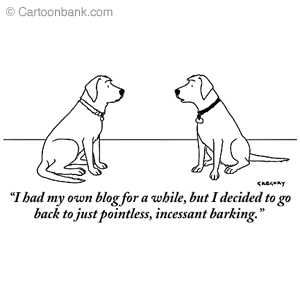
And now those cartoons I promised, either or both of which may or may not apply to me.

LinkWithin

Related Posts with Thumbnails